Kitchen Countertop Ideas
Your kitchen countertop is more than a work surface. It anchors the entire room’s design, absorbs daily punishment, and sets the tone for how the space feels. Getting it right — choosing the material, edge profile, color, and finish — can make an ordinary kitchen feel genuinely special. Whether you’re starting from scratch or refreshing what’s already there, this guide walks you through every meaningful option.
Why countertops matter more than most upgrades
Of all the changes you can make to a kitchen, countertops deliver one of the highest returns on investment — both financially and aesthetically. They cover significant square footage, interact with light throughout the day, and are touched constantly. A beautiful cabinet door may go unnoticed; a beautiful countertop never does.
Before diving into materials, consider three questions: How do you actually use your kitchen? Do you cook heavily, entertain often, or mostly order in? How important is low maintenance? And what is your honest budget — not just for the material itself, but for fabrication, installation, and any edge detailing?
The major materials, honestly assessed
Quartz (Engineered Stone)

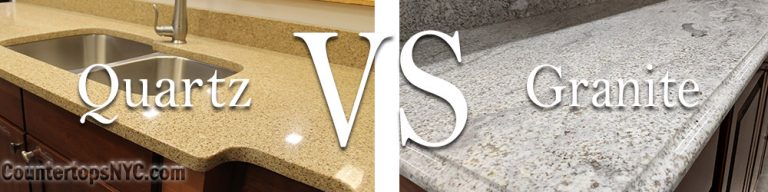
The most popular choice today for good reason. Quartz countertops are engineered from ground stone and resin, making them non-porous, highly stain-resistant, and remarkably consistent in appearance. They don’t require sealing, shrug off most spills, and come in an enormous range of colors — from clean whites to bold veined patterns that rival natural stone. The trade-off: they can look slightly artificial under close inspection, and very high heat can damage the resin binders.
Granite

Still a benchmark for kitchen elegance. Every slab of granite is unique, with natural movement, depth, and variation no manufactured product can fully replicate. It handles heat well and, when properly sealed, resists staining. The downsides are the need for periodic resealing and the fact that pattern consistency across a large kitchen can be difficult to control. Granite rewards kitchens that embrace natural character over uniformity.
Marble
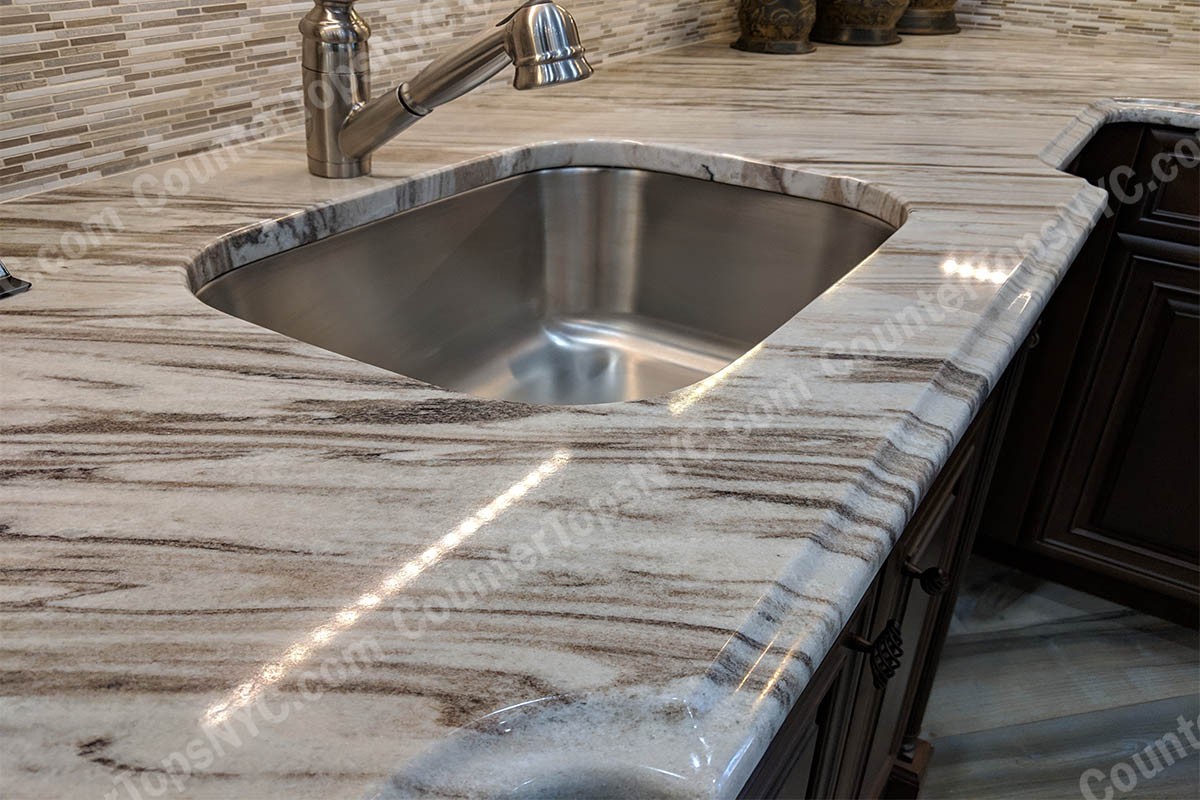
The aspirational choice. Marble’s veining and luminous depth are unmatched, and a well-chosen slab can elevate a kitchen into something that feels genuinely curated. That said, marble is porous, acid-sensitive, and will etch and patina over time. Many designers argue this “living surface” quality is part of its charm. Others find it too demanding. If you bake regularly, a marble island or baking section is a particularly practical and beautiful application.
Butcher Block (Wood)
Warm, tactile, and surprisingly durable when maintained properly. Wood countertops bring a natural softness to kitchens that stone cannot match, and they can be sanded and refinished if scratched or stained — a forgiving quality stone lacks entirely. They work brilliantly as a contrasting island surface against a stone perimeter, adding material variety and visual interest. Regular oiling is required.
Concrete
For kitchens that want an industrial, artisanal, or highly customized look, poured and polished concrete is unbeatable in its flexibility. It can be tinted, embedded with aggregates or objects, and shaped to any specification. The surface requires sealing and some maintenance, and can develop hairline cracks over time — qualities that contribute to its unique character.
Porcelain Slab
One of the fastest-growing choices in modern kitchen design. Ultra-thin, extremely hard, scratch- and heat-resistant, and available in large formats that minimize seams. Porcelain can convincingly mimic marble, stone, and concrete — often at a lower price point — while requiring almost no maintenance. Ideal for sleek, contemporary kitchens.
Laminate
Significantly more sophisticated than its reputation. Modern high-pressure laminate (HPL) has improved dramatically in texture, finish quality, and durability. It remains the most budget-accessible surface option, and in a thoughtfully designed kitchen, it can look remarkably intentional. Best for lower-traffic kitchens or areas where budget must be allocated elsewhere.
Design Note
Mixing two materials — stone for the perimeter and wood for the island, or marble for the main counter and concrete for a baking section — adds depth and intentionality to a kitchen. It signals a designed space rather than a default one.
Approximate cost by material
Prices below reflect installed cost per square foot in the US market and vary significantly by region, slab quality, and edge detailing.
Edge profiles: the detail that changes everything
The edge profile is an often overlooked design decision that significantly affects the feel of a kitchen. A straight eased edge reads as modern and clean. A classic ogee or bullnose softens the look and reads as traditional. A waterfall edge — where the countertop material drops straight down the side of the island — is one of the most striking moves in contemporary kitchen design, especially in book-matched stone or veined quartz.
More elaborate profiles (ogee, dupont, cove) cost more to fabricate but can make a relatively simple material feel significantly more refined. Simpler profiles work best in modern kitchens; ornate profiles belong in transitional or traditional spaces.
Color and finish direction
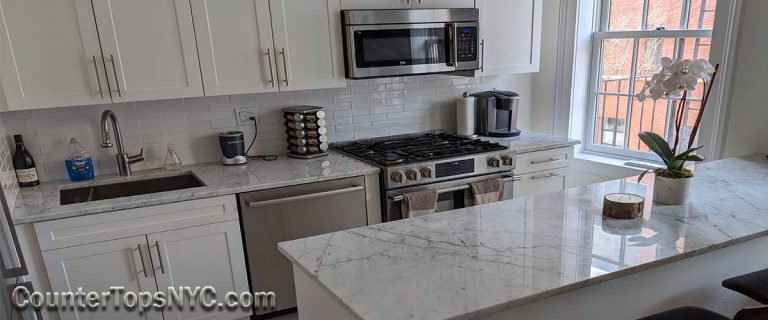
White and off-white countertops remain the most versatile choice — they open up a kitchen, work with almost any cabinet color, and photograph well. Warm whites (Calacatta-style with gold veining) suit warmer wood tones; cooler whites (Carrara-style with gray veining) pair naturally with painted cabinetry.
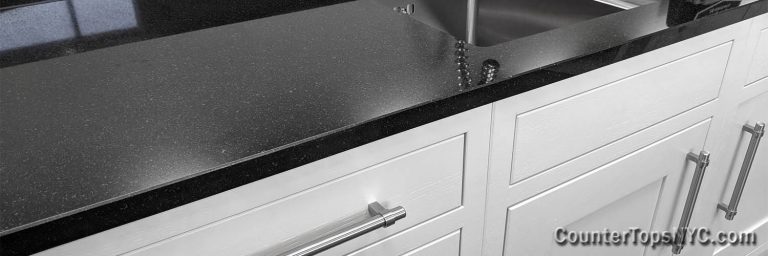
Dark countertops — charcoal, deep green, black — have gained significant ground in recent years. Against white or natural wood cabinetry, a dark stone creates dramatic contrast and a grounded, considered aesthetic. They do show dust and water spots more readily, a practical trade-off worth acknowledging.
Matte and honed finishes are increasingly preferred over high-gloss polished surfaces for a softer, more sophisticated look. They show fingerprints and scratches less aggressively and feel more tactile to the touch.
Planning your remodel: a practical sequence
- Define your priorities before visiting showrooms. Durability, aesthetics, maintenance tolerance, and budget should each be ranked honestly before you see anything that might sway you.
- Visit a stone yard or fabricator in person. Photographs of stone are almost useless for making a real decision — variation, movement, and depth only reveal themselves at full scale.
- Pull samples into your actual kitchen. Light conditions change dramatically from showroom to home; colors that look one way under commercial lighting behave differently under your specific conditions.
- Choose your edge profile at the same time as your material. The two decisions affect each other and should not be treated separately.
- Clarify the seam plan for large kitchens. Seam placement is a functional and aesthetic decision that deserves a direct conversation with your fabricator before work begins.
- Factor in the backsplash relationship. A complex stone countertop often calls for a simpler backsplash, and vice versa. Designing both in isolation is one of the most common remodeling mistakes.
Before You Commit
Ask your fabricator to show you the actual slab you will be cutting from — not a sample tile. For natural stone especially, the character of individual slabs varies enormously. Seeing exactly what you’re getting eliminates most disappointment.
Small changes, large impact
Not every countertop remodel requires a full replacement. Resurfacing with concrete overlay, applying an epoxy refinishing kit to laminate, or replacing only the island countertop while leaving the perimeter intact are all legitimate options that can meaningfully refresh a kitchen at a fraction of full replacement cost.
Undermount sinks — which require a solid countertop material — instantly make a kitchen feel more refined by eliminating the rim that collects debris. If you’re already replacing your countertops, upgrading the sink opening to undermount simultaneously is one of the highest-value additions to the project.
“A kitchen should be designed for the life you actually live in it — not the kitchen photography you admire.”
Whatever material you choose, the most important thing is that the decision is deliberate. The kitchens that feel genuinely well-designed are rarely those with the most expensive surfaces — they’re the ones where every choice, from material to edge to color to finish, was made with intention and executed with care.